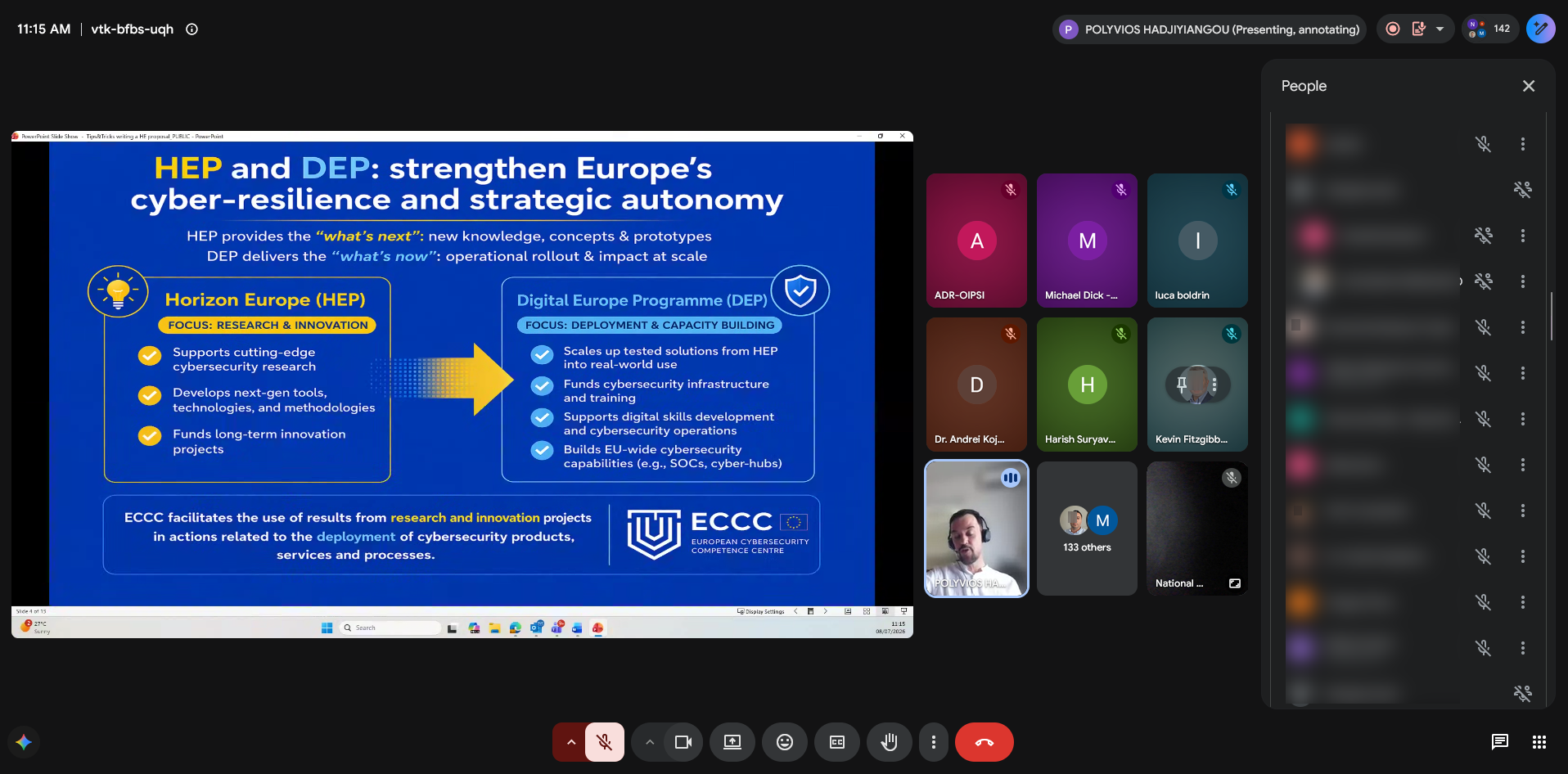
The NCC-CY successfully held an online Info Day to present the new Cybersecurity Call for proposals under the Horizon Europe Programme (HORIZON-CL3-2025-02-CS-ECCC).
News
Monday, 30/06/2025
Successfully completed the Online Info Day on New Funding Calls for Cybersecurity under the Horizon Europe programme
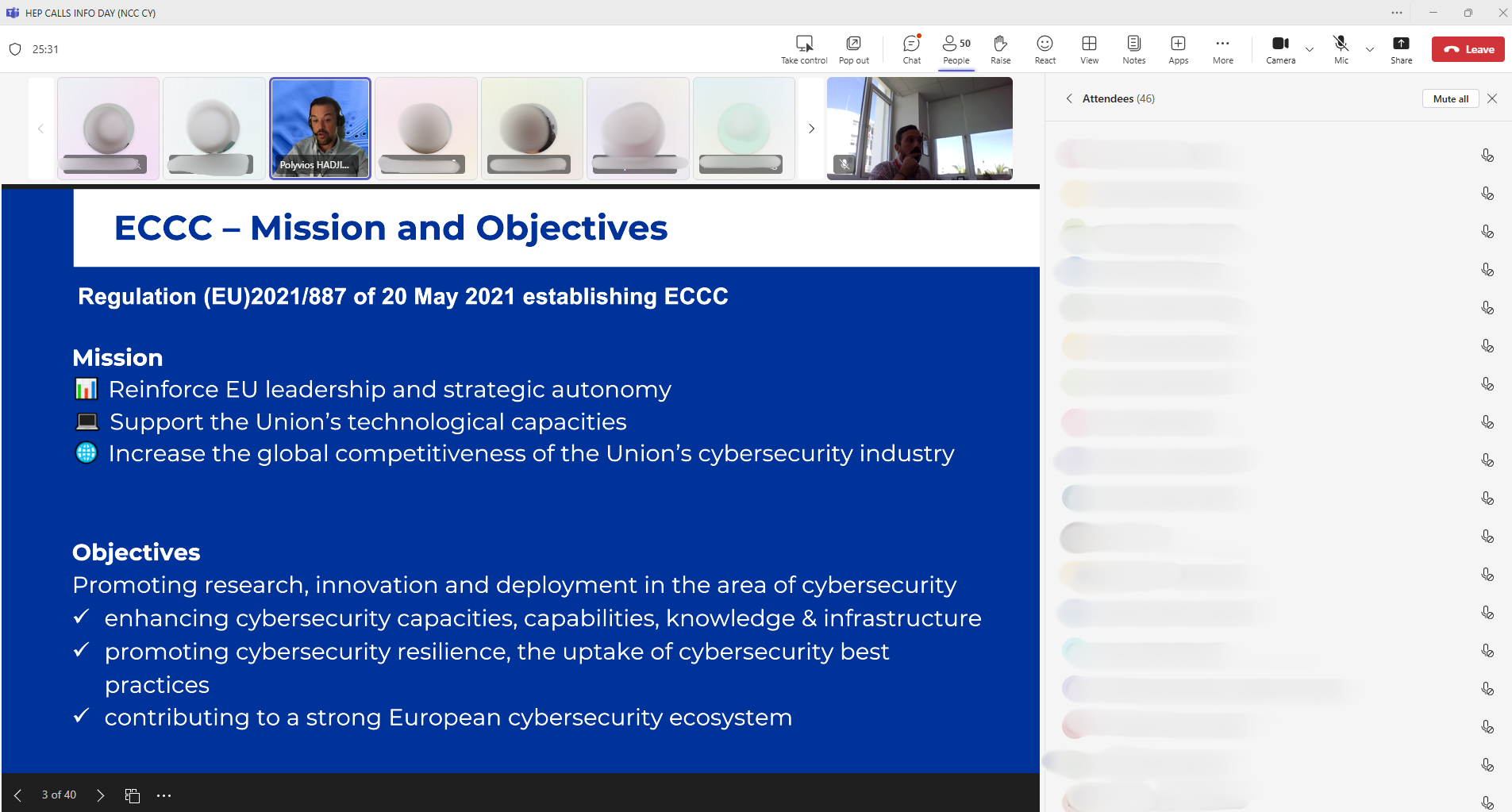
The keynote speaker was Mr. Polyvios Hadjiyiangou, Head of Operation ECCC. The event was coordinated by Mr. Polis Peratikos, Senior Officer at the NCC-CY.
The aim of the webinar was to raise awareness about the new European funding opportunities for cybersecurity development activities.
The call focuses on the following key areas:
1) Generative AI for Cybersecurity applications
Generative AI offers both opportunities and challenges in cybersecurity. This topic supports research into how Generative AI can enhance threat detection, accelerate response times, manage large data volumes, and automate processes—such as generating threat reports, writing detection rules and queries for SIEM, producing compliance reports, and reverse-engineering malware.
2) New advanced tools and processes for Operational Cybersecurity
Proposals are expected to demonstrate the developed frameworks, tools, services, and processes through pilot implementations involving the participation of relevant national cybersecurity authorities and/or essential and important entities as defined in NIS2, implemented with the participation of leading European cybersecurity industry. Proposals should consider the impact of forthcoming legislation, in particular the Cyber Resilience Act.
3) Privacy Enhancing Technologies
Protecting personal data and privacy is essential, especially during data analysis. Privacy-preserving techniques limit data collection and use, applying advanced cryptography. While machine learning extracts insights from medical and behavioral data, the inclusion of sensitive information poses risks of breaches, threatening individual privacy and broader societal and economic security.
4) Security evaluations of Post-Quantum Cryptography (PQC) primitives
The security of post-quantum cryptography (PQC) relies on mathematical problems considered hard for both classical and quantum computers. Assessing the quantum resistance of PQC primitives is crucial to build trust in these systems. Significant quantum algorithm speed-ups would require reevaluating the security of cryptosystems like lattice- and code-based schemes. If no such speed-ups emerge, confidence in PQC grows, though some parameters may need adjustment.
5) Security of implementations of Post Quantum Cryptography algorithm
The security of PQC implementations is crucial to protect digital data against attacks like side-channel and fault attacks, which exploit timing, power, or electromagnetic leaks. These threats, sometimes enhanced by deep learning, target both software and hardware in areas like IoT and automotive. Preventing such attacks often adds significant resource overhead, while security remains uncertain due to limited study of attack surfaces. Available countermeasures can impact performance and memory, making resistance to implementation attacks a key concern for balancing security and efficiency.
6) Integration of Post-Quantum Cryptography (PQC) algorithms into high-level protocols
Transitioning to post-quantum cryptography means replacing most current public-key systems like RSA and ECC. Research is developing quantum-resistant signature and key-exchange methods, aiming to integrate them into core protocols such as TLS.